photograph

photograph

The Photograph

“...and lo, I am with you always, even unto the end of the world. Amen." (Matthew 28:20) kjv
Protected by Copyscape Online Infringement Checker

Introduction:

My photo
Current: Danbury, CT, United States
Welcome! A few years ago, I discovered an application that artists employ in their works to bring cultural awareness to their audiences. Having discerned this semiotic theory that applies to literature, music, art, film, and the media, I have devoted the blog,Theory of Iconic Realism to explore this theory. The link to the publisher of my book is below. If you or your university would like a copy of this book for your library or if you would like to review it for a scholarly journal, please contact the Edwin Mellen Press at the link listed below. Looking forward to hearing from you!

Thank you for visiting. I hope you will find the information insightful. ~ Dr. Jeanne Iris

Announcements:

I have demonstrated or will demonstrate the application of this theory at the following locations:

2026: I am writing my third book on iconic realism.

November 2025: New England Regional Conference for Irish Studies, Massachusetts College of Liberal Arts, "Sociolinguistic Evidence in James Joyce’s Ulysses: The Use of Language to Express the Semiotic Theory of Iconic Realism"

April 2022: American Conference for Irish Studies, virtual event: (This paper did not discuss Sydney Owenson.) "It’s in the Air: James Joyce’s Demonstration of Cognitive Dissonance through Iconic Realism in His Novel, Ulysses"

October, 2021: Sacred Heart University, Fairfield, CT: "Sydney Owenson’s use of sociolinguistics and iconic realism to defend marginalized communities in 19th century Ireland"

March, 2021: Lenoir-Rhyne University, Hickory, North Carolina: "Sydney Owenson (Lady Morgan): A Nineteenth Century Advocate for Positive Change through Creative Vision"

October, 2019: Elms College, Chicopee, Massachusetts: "A Declaration of Independence: Dissolving Sociolinguistic Borders in the Literature of Sydney Owenson (Lady Morgan)"

10 January, 2026

'Blind Girl at a Holy Well...' by Frederic W. Burton and Iconic Realism

Below is an excerpt from a paper I was beginning to present at a New England Regional Meeting of the American Conference for Irish Studies. Unfortunately, I came down with the Noro virus and had to leave the conference suddenly and drive across the entire state of Connecticut… sick as a dog. Ugh! What a memory… Anyway, enjoy this excerpt that I never was able to present completely. 


Blind Girl at a Holy Well - a Scene in the West of Ireland
Painting by Frederick William Burton

In Frederic William Burton's painting, Blind Girl at a Holy Well - a Scene in the West of Ireland, we could broaden our interpretation to consider who Burton was representing through this young, blind girl. Notice that the younger girl serves as blind girl's ‘eyes.’  Through the establishment of the iconic figure of a blind girl within the mind-set of the community, Burton places this icon in a new reality that the community does not usually accept as the normal setting for this iconic figure: a blind girl gathering water at a well. This placement allows the artist to make a statement that brings awareness to the community’s consciousness of an aspect within its culture that may need some attention. 

In Burton's painting, the commonplace figures become associations of those communal concepts to which many members can relate on a personal level: hope, industriousness and innocence, all of which he creates in the necessary function of gathering water. In Luke 6:39,  Jesus asks His disciples, "Can a blind person guide a blind person?" In this painting, the audience can "see" the necessity for others to help those, who are blinded, in the human act of quenching thirst, be that a physical, emotional, or political thirst.

09 January, 2026

Margaret Mitchell's Scarlet O'Hara and Iconic Realism (Click here to view a clip from the film, Gone with the Wind.)

Photo from Google Images
"As God is my witness, they're not going to lick me. 
I'll never be hungry again, nor any of my folks..."

Margaret Mitchell's Pulitzer Prize winning novel, Gone with the Wind, beautifully illustrates the semiotic theory of iconic realism. She places a gentle young woman, raised on a southern plantation, in the midst of the American Civil War (or War of Northern Aggression, as they say south of the Mason-Dixon Line). Through this juxtaposition, Mitchell makes her audience aware of the need for perseverance to maintain one's dignity, personally and culturally.

In the scene above, Scarlet emerges from Tara, fatigued and tattered like a wilted magnolia blossom, but she slowly elevates herself as the horizon brightens. Her spirit breathes life back into this flower as a nation learns to cultivate the quality of innovation.

This novel was published in 1936, during the midst of the Great Depression when millions of Americans needed the kind of determination that the character, Scarlet O'Hara, exhibited. In addition, the interaction between the various characters throughout this novel illustrates a need for cultural reform on many levels.

08 January, 2026

James Joyce's Ulysses and Iconic Realism: Molly Bloom

Ha'Penny Bridge: Photo taken May, 2011

Below is an excerpt from a chapter, which I contributed to the book entitled, 
Breaking the Mould: Literary Representation of Irish Catholicism in Literature. 

James Joyce illustrates iconic realism by means of Victorian feminine perceptions throughout Molly Bloom’s soliloquy in the final chapter of his epic tale, Ulysses. Using stream of consciousness in a manner unparalleled at this novel’s publication, Joyce leads his audience to the entrance of the sphere of Molly’s mind, taking the reader to every crevice of her feminine consciousness. Joyce defies the social stigma of women during this era as he interweaves Molly Bloom’s expression of a unique feminine point of view.

Through Molly’s voice, he seeks answers to his own challenge with a feminine defiance of human weakness. The Ireland in which James Joyce lives is in the midst of revolution. As Joyce leaves his ancestral home, he allows his own genius to flourish. He sees the result of the male world’s design for women and seeks to illuminate the world with its significance. His personal associations with women frame the female portrait of Molly Bloom, as he places Molly in the midst of the Victorian era, with its focus on proper placement of gender roles, customs and even nations, carries the burden of living with this regimented philosophical point of view.

Joyce designs the person of Molly to reveal traits that originate from conventional Victorian male ideas of how a woman should act or think. Joyce writes Molly as one whose actions with a particular tendency to focus upon her sexual desires. Molly, like Ireland, is a contradiction of human spirit. On one hand, she is independent, wild, yet she depends on the ruler of her heart for identity. Nevertheless, Joyce uses outspoken behavior by Molly to reveal his personal hopeful desire for Ireland, one that seeks to declare independence from the established English Common law.

© Jeanne I. Lakatos

07 January, 2026

Definition of the Semiotic Theory of Iconic Realism

Note: Occasionally, I post this to let any reader know what my semiotic theory actually is. Hope this brings some clarity for you. Cheers! 

Definition of the Semiotic Theory of Iconic Realism

by Jeanne I. Lakatos

Realism comprises authentic and independent aspects of the natural world, which individuals comprehend through sensory perception. The term icon describes a realistic person or realistic object, categorically perceived by a population as representative of a specific human activity or an object that bears significance to human activity. Iconic realism, then, involves the placement of an icon within the midst of a unique realistic setting, out of place for this particular icon, creating a static coalescence of the icon with the designated realism. Since both the icon and the realistic setting represent an aspect of the culture, the resulting friction between these two entities is the catalyst that generates enlightenment of a cultural dilemma. 

I used visual examples of iconic realism as the cover photos for my books, pictured below.
(Book #3 is forthcoming.)


06 January, 2026

Bostonian, Mercy Otis Warren, "Muse of the American Revolution"


Mercy Otis Warren, photo from cover of book:
Mercy Otis Warren: The Muse of the American Revolution

Mercy Otis Warren was born in 1728 in Boston, Massachusetts. Her father was a successful businessman and an acquaintance of John Adams and his family and circle of friends. Warren observed the intensity with which her contemporaries had to live in order to receive the dignified respect that any human being would rightly expect to receive. Within her plays and essays, she included the concept of human rights advocacy and relevant themes of independence, juxtaposed with iconic characters and structures to bring awareness to her audience of the need for social and political transformation.

For example, in her 1773 play, The Adulateur, Warren described the issue of individual rights through the speech of her main character, Brutus:

            The change how drear! The sullen ghost of bondage
            Stalks full in view—already with her pinions,
            She shades the affrighted land—the insulting soldiers
            Tread down our choicest rights; while hoodwinked justice
            Drops her scales, and totters from her basis.
            Thus torn with nameless wounds, my bleeding country
            Demands a tear – that tear I’ll freely give her. 


[1] Mercy Otis Warren, The Adulateur, Act I, Scene I, Boston: New Printing Office, 1773.
        

04 January, 2026

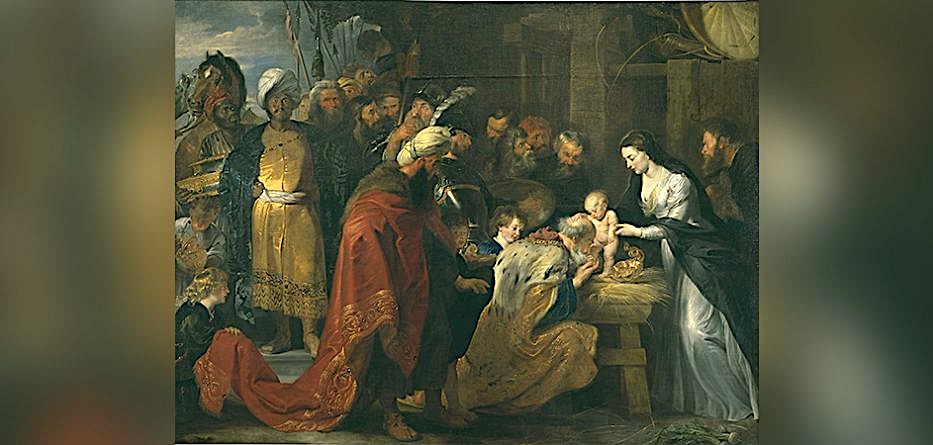
The Epiphany, Charles Wesley's Hymn "Hark the Herald Angels Sing," and Iconic Realism


 "Adoration of the Magi" by Peter Paul Rubens (1577–1640). 
Image: Musée des Beaux-Arts, Lyon, France

The Epiphany: 

The Epiphany is the Christian celebration of the Infant Jesus and recognition of His divinity as the three kings of the East present gifts of gold, frankincense and myrrh to the Infant Jesus in the manger. Many have attached symbolic meanings to these gifts, and that is still up for discussion. However, this Biblical event does illustrate my semiotic theory of iconic realism in the following manner: 

1. A baby is born in a lowly place, surrounded by the warmth and comfort of His mother, father, and domestic barn animals. 

2. The baby and His family receive elite visitors, who had followed a star leading to this location. They kneel and worship the infant in this lowly place. Then, they present Him with extravagant gifts of gold, frankincense, and myrrh. These are not the usual gifts given to a newborn infant. 

3. This presentation illustrates the juxtaposition of Divinity and humility. Thus, through humble means, people can accept Divine Love and find purpose within their lives. 

***************************************************************************

The hymn, "Hark the Herald Angels Sing:'

In the mid-eighteenth century, Charles Wesley wrote lyrics to hymns that Christians sing to this day. His hymns are instructive and relevant to the daily journey in which we engage. The 1739 hymn, "Hark the Herald Angels Sing," is often sung in churches after Christmas Eve, for this hymn explains the purpose of Jesus' birth. This hymn is an excellent one for the Epiphany because the lyrics describe the brilliant skies of Bethlehem after Jesus had been born, providing all with knowledge of God's light in each life, just as the Magi experienced as they greeted the newborn King with humility and grace. 

How does this Christmas hymn reflect iconic realism? 

1. Iconic angels sing in the evening skies, as they declare the "Glory to the newborn King" and these beings are seen by all those who look up into this glorious scene, including the lowliest of humanity. 

2. The lines, "Veiled in flesh the Godhead see; Hail the incarnate Deity," place this innocent baby in the  role of Godliness even at His birth, an unusual role for one at this time in His life. 

3. The final verse demonstrates the Divine purpose of His birth in the following lines: 
Light and life to all He brings
Ris’n with healing in His wings
Mild He lays His glory by
Born that man no more may die
Born to raise the sons of earth
Born to give them second birth

He will bring enlightenment, life, and healing through his patient and 'mild' mannerisms, for He was born to bring everlasting life, and to show humanity the fulfillment of the 'second birth,' in current terms, being  born again.


'Hark the Herald Angels Sing' 
A hymn written by Charles Wesley, 1739

Hark the herald angels sing
“Glory to the newborn King!
Peace on earth and mercy mild
God and sinners reconciled”
Joyful, all ye nations rise
Join the triumph of the skies
With the angelic host proclaim:
“Christ is born in Bethlehem”
Hark! The herald angels sing
“Glory to the newborn King!”

Christ by highest heav’n adored
Christ the everlasting Lord!
Late in time behold Him come
Offspring of a Virgin’s womb
Veiled in flesh the Godhead see
Hail the incarnate Deity
Pleased as man with man to dwell
Jesus, our Emmanuel
Hark! The herald angels sing
“Glory to the newborn King!”

Hail the heav’n-born Prince of Peace!
Hail the Son of Righteousness!
Light and life to all He brings
Ris’n with healing in His wings
Mild He lays His glory by
Born that man no more may die
Born to raise the sons of earth
Born to give them second birth
Hark! The herald angels sing
“Glory to the newborn King!”