photograph

photograph

The Photograph

“...and lo, I am with you always, even unto the end of the world. Amen." (Matthew 28:20) kjv Photo is a bee sipping the nectar from honeysuckle that was growing along an old rock wall.
Protected by Copyscape Online Infringement Checker

Introduction:

My photo
Current: Danbury, CT, United States
Welcome! A few years ago, I discovered an application that artists employ in their works to bring cultural awareness to their audiences. Having discerned this semiotic theory that applies to literature, music, art, film, and the media, I have devoted the blog,Theory of Iconic Realism to explore this theory. The link to the publisher of my book is below. If you or your university would like a copy of this book for your library or if you would like to review it for a scholarly journal, please contact the Edwin Mellen Press at the link listed below. Looking forward to hearing from you!

Thank you for visiting. I hope you will find the information insightful. ~ Dr. Jeanne Iris

Announcements:

I have demonstrated or will demonstrate the application of this theory at the following locations:

2026: I am writing my third book on iconic realism.

November 2025: New England Regional Conference for Irish Studies, Massachusetts College of Liberal Arts, "Sociolinguistic Evidence in James Joyce’s Ulysses: The Use of Language to Express the Semiotic Theory of Iconic Realism"

April 2022: American Conference for Irish Studies, virtual event: (This paper did not discuss Sydney Owenson.) "It’s in the Air: James Joyce’s Demonstration of Cognitive Dissonance through Iconic Realism in His Novel, Ulysses"

October, 2021: Sacred Heart University, Fairfield, CT: "Sydney Owenson’s use of sociolinguistics and iconic realism to defend marginalized communities in 19th century Ireland"

March, 2021: Lenoir-Rhyne University, Hickory, North Carolina: "Sydney Owenson (Lady Morgan): A Nineteenth Century Advocate for Positive Change through Creative Vision"

October, 2019: Elms College, Chicopee, Massachusetts: "A Declaration of Independence: Dissolving Sociolinguistic Borders in the Literature of Sydney Owenson (Lady Morgan)"

05 February, 2026

Robert Frost's "The Oven Bird" and Iconic Realism (Click onto this title to hear and see an ovenbird.)


(Oven Bird photo from Google Images)

The Ovenbird
by Robert Frost
There is a singer everyone has heard,

Loud, a mid-summer and a mid-wood bird,

Who makes the solid tree trunks sound again.

He says that leaves are old and that for flowers

Mid-summer is to spring as one to ten.

He says the early petal-fall is past

When pear and cherry bloom went down in showers

On sunny days a moment overcast;

And comes that other fall we name the fall.

He says the highway dust is over all.

The bird would cease and be as other birds

But that he knows in singing not to sing.

The question that he frames in all but words

Is what to make of a diminished thing.

Robert Frost's poetry portrays the enigma of humanity through his observations of nature. His poem, "The Ovenbird," is no exception. The high-pitched song of this bird reminds the busy human of the lessons learned through the simplicity of nature.

The iconic structure here is the oven bird, a woodland icon, representing the natural progression of life. In the tenth line, Frost points out, "He says the highway dust is over all." This line is unusual in that it follows vivid, natural imagery that awakens the reader to the conflict between humanity's impact versus the seemingly insignificant bird. A bird whose voice sounds like a song to us, but to the bird, it's simply communicating to other birds in a natural way, "not to sing.”

In this poem, Frost also illustrates through the passage, "Mid-summer is to Spring as one is to ten," the necessity of a natural sequence and the devastation that can exist when humanity interrupts or neglects this natural progression. 

This could also pertain to each of us. We must follow a natural sequence in our individual lives, for if we do not, we could take a path that causes pain and dissonance, which is why we must align our hearts with the One who guides us throughout our lives...in God's time. 

To hear me read this, please click HERE.

01 February, 2026

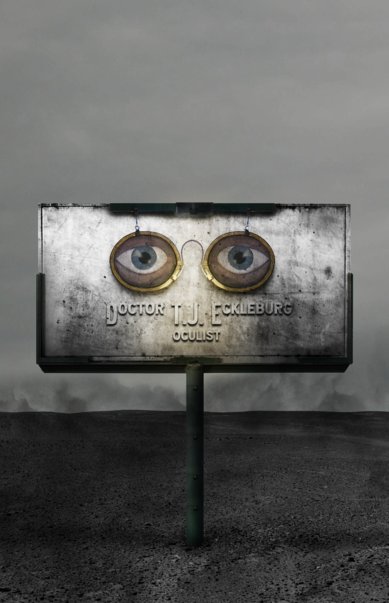
F. Scott Fitzgerald: The Eyes of Dr. T.J. Eckleburg and Iconic Realism


But above the gray land and the spasms of bleak dust, which drift endlessly over it, you perceive, after a moment, the eyes of Doctor T. J. Eckleburg. The eyes of Doctor T. J. Eckleburg are blue and gigantic—their irises are one yard high. They look out of no face, but, instead, from a pair of enormous yellow spectacles which pass over a nonexistent nose. Evidently, some wild wag of an oculist set them there to fatten his practice in the borough of Queens, and then sank down himself into eternal blindness, or forgot them and moved away. But his eyes, dimmed a little by many painless days, under sun and rain, brood on over the solemn dumping ground. (F. Scott Fitzgerald, The Great Gatsby, Chapter 2)

In F. Scott Fitzgerald’s, The Great Gatsby, the eyes of Dr. T.J. Eckleburg peer across the ‘dumping ground’ of American spirit. How does this exemplify my theory of iconic realism? 
1. Fitzgerald portrays eyes as the ‘windows of the soul’ of a country steeping in corruption and superficiality. 
2. Fitzgerald places these eyes on an old billboard, gazing across a field of forgotten possessions, an unusual placement of such representatives of the soul of a nation. 
3. Fitzgerald brings into focus America’s need to appreciate all members of society, maintaining a mindset to be ever vigilant of the forefathers’ intentions of "life, liberty, and the pursuit of happiness."