photograph

photograph

The Photograph

“...and lo, I am with you always, even unto the end of the world. Amen." (Matthew 28:20) kjv
Protected by Copyscape Online Infringement Checker

Introduction:

My photo
Current: Danbury, CT, United States
Welcome! A few years ago, I discovered an application that artists employ in their works to bring cultural awareness to their audiences. Having discerned this semiotic theory that applies to literature, music, art, film, and the media, I have devoted the blog,Theory of Iconic Realism to explore this theory. The link to the publisher of my book is below. If you or your university would like a copy of this book for your library or if you would like to review it for a scholarly journal, please contact the Edwin Mellen Press at the link listed below. Looking forward to hearing from you!

Thank you for visiting. I hope you will find the information insightful. ~ Dr. Jeanne Iris

Announcements:

I have demonstrated or will demonstrate the application of this theory at the following locations:

2026: I am writing my third book on iconic realism.

November 2025: New England Regional Conference for Irish Studies, Massachusetts College of Liberal Arts, "Sociolinguistic Evidence in James Joyce’s Ulysses: The Use of Language to Express the Semiotic Theory of Iconic Realism"

April 2022: American Conference for Irish Studies, virtual event: (This paper did not discuss Sydney Owenson.) "It’s in the Air: James Joyce’s Demonstration of Cognitive Dissonance through Iconic Realism in His Novel, Ulysses"

October, 2021: Sacred Heart University, Fairfield, CT: "Sydney Owenson’s use of sociolinguistics and iconic realism to defend marginalized communities in 19th century Ireland"

March, 2021: Lenoir-Rhyne University, Hickory, North Carolina: "Sydney Owenson (Lady Morgan): A Nineteenth Century Advocate for Positive Change through Creative Vision"

October, 2019: Elms College, Chicopee, Massachusetts: "A Declaration of Independence: Dissolving Sociolinguistic Borders in the Literature of Sydney Owenson (Lady Morgan)"

27 August, 2026

Benny Goodman Live at Carnegie Hall, 1938 and Iconic Realism (Click onto title to hear the performance.) I'll just bet you can't sit still whilst listening to this!

(Photograph info: http://www.britannica.com/EBchecked/topic-art/243118/72265/Benny Goodman-and-members-of-his-band-1938) 

Benny Goodman and his orchestra appearing on the stage of Carnegie Hall in New York City in 1938 illustrates the theory of iconic realism. Never before had the art of jazz in America been performed in an established musical forum, where previous to this performance, only classical music had been performed. The presence of this jazz artist on this particular stage enlightened the world audience of the need for cultural affirmation of this art form. From this moment onward to the present, jazz has taken its place of honor as America's original musical genre. 


26 August, 2026

Dante Alighieri's "Paradiso" and Iconic Realism


Photo from Google Images
http://kidslink.bo.cnr.it/ic6-bo/scuolainospedale/num6-2/divcom/Image8.jpg

Dante Alighieri's final book of The Divine Comedy is Paradiso. In this book, he demonstrates the theory of iconic realism in this way:  
1.  He aligns the spirit of the beloved Beatrice with the true wisdom of God.
2.  He simultaneously illustrates the need for humanity to acknowledge the glorious virtues found within the parameters of human interaction. 
3.  He illustrates that by the human being choosing right action, he could experience a form of Paradiso.

In CANTO IV, lines 28-39: The souls exist as projections of their truest light, the light that shines directly from God, which is their 'true home' whereas in lines 72-81, what the Pilgrim cannot learn directly must be taught him through a suffering analogy involving the senses, human physiological experience. This contradicts the earlier lines that indicate truth as intangible and experienced only through one's own enlightenment from God. 

The human's personal will can enjoy freedom to move of his own accord; he can act in response to the intensity of individual motivation. When perfect, Divine balance exists between two motives, and the will could feel deprived of its power to move. It could thus become paralyzed. A paradox that remains is humanity needs to interact with others; however, some may resist the positive risk of relying on God to help us take the right and effective action. The result could be either apathy or right action. We must decide. Paradise could exist anywhere, even on a mountaintop. 

CANTO IV
Lines 28-39:
Choose the most God-like of the Seraphim---     
    take Moses, or Samuel, or take either John, 
    or even Mary--- not one is nearer Him,                 30

nor holds his seat atop the blessed spheres
    in any heaven apart from those you saw; 
    nor has his being more or fewer years.

All add their beauty to the Highest Wheat, 
    share the sweet life, and vary n it only                   35
    by how much of the Eternal Breath they feel.

They showed themselves here not because this post
    has been assigned them, but to symbolize
    that they stand lowest in the Heavenly host.

Lines 72-81: 
" --If violence, to begin,
     occurs when those who suffer its abuse
     contribute nothing to what forces them, 
     then these should have no claim to that excuse.   75

For the will, if it will not, cannot be spent,
     but does as nature does within a flame
     a thousand or ten thousand winds have bent.       

If it yields of itself, even in the least, 
     Then it assists the violence -- as did these            80
     who could have gone back to their holy feast. 

from: The Divine Comedy by Dante Alighieri
Translated by John Ciardi 
New American Library, 2003

25 August, 2026

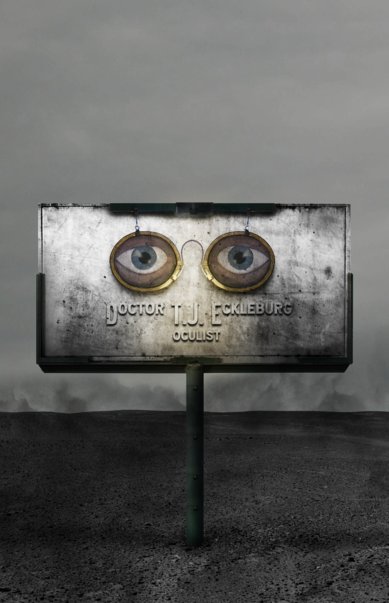
F. Scott Fitzgerald: The Eyes of Dr. T.J. Eckleburg and Iconic Realism


But above the gray land and the spasms of bleak dust, which drift endlessly over it, you perceive, after a moment, the eyes of Doctor T. J. Eckleburg. The eyes of Doctor T. J. Eckleburg are blue and gigantic—their irises are one yard high. They look out of no face, but, instead, from a pair of enormous yellow spectacles which pass over a nonexistent nose. Evidently, some wild wag of an oculist set them there to fatten his practice in the borough of Queens, and then sank down himself into eternal blindness, or forgot them and moved away. But his eyes, dimmed a little by many painless days, under sun and rain, brood on over the solemn dumping ground. (F. Scott Fitzgerald, The Great Gatsby, Chapter 2)

In F. Scott Fitzgerald’s, The Great Gatsby, the eyes of Dr. T.J. Eckleburg peer across the ‘dumping ground’ of American spirit. How does this exemplify my theory of iconic realism? 
1. Fitzgerald portrays eyes as the ‘windows of the soul’ of a country steeping in corruption and superficiality. 
2. Fitzgerald places these eyes on an old billboard, gazing across a field of forgotten possessions, an unusual placement of such representatives of the soul of a nation. 
3. Fitzgerald brings into focus America’s need to appreciate all members of society, maintaining a mindset to be ever vigilant of the forefathers’ intentions of "life, liberty, and the pursuit of happiness."


24 August, 2026

'Balzac and the Little Chinese Seamstress' by Dai Sijie and Iconic Realism


The novella, Balzac and the Little Chinese Seamstress by Dai Sijie presents teenage students, who taste all that is forbidden in a 're-education' camp in the remote hills of China during the Chinese cultural revolution of the 1970's: music, literature, love, and freedom. Dai Sijie writes this beautiful tale as both a novella and a screenplay. Placing the intensive longing for education in a communist environment where knowledge was prohibited, he illustrates through the use of iconic realism that creativity and the hunger for knowledge of self and the world perseveres within the human spirit.  


23 August, 2026

Brian Eno's Ambient Music and Iconic Realism (Click here to view and hear video of Eno's Earth, "An Ending")

A photo of a nearby lake at sunset

From my first book on the semiotic theory of iconic realism: 

Some musical composers apply electronically produced music with natural sounds from the environment to provide the audience with a real association, such as wildlife, bodies of water, seasonal sound sources, and weather phenomena. This particular form of musical presentation, known as ambient music, for its affect on the ambience of one’s surroundings, is often recorded for health facilities. 
  
An example of such musical composition is the healing music of composer, Brian Eno, and his 1978 release, Ambient I: Music for Airports. In the liner of this album, Eno writes, “My intention is to produce original pieces ostensibly (but not exclusively) for particular times and situations with a view to building up a small but versatile catalogue of environmental music suited to a wide variety of moods and atmospheres.”[1] This form of incorporating musical sounds with nature provides the added aesthetic of stimulating the senses with a portion of reality to which the audience relates through memory, transporting an individual to an aspect of memory, aligning the audience with the composer’s perception of reality. 

In his musical composition, Earth, An Ending, he provides the audience with a reality that heightens awareness of the possibility of positive cultural change either within an individual or within Earth’s community as a whole.

[1] Eno, Brian. Music for Airports/Ambient 1. Liner notes. PVC 7908 (AMB 001), 1978.